#IMaySayThat
On the debate about alienation in Germany. Guest post by Gita Timm

In my recent article “Welcome back to Berlin!” I linked to a text by Gita Timm, who grew up in Germany as the daughter of immigrants. With her permission, I am publishing the full text, which I have translated into English from the original version.
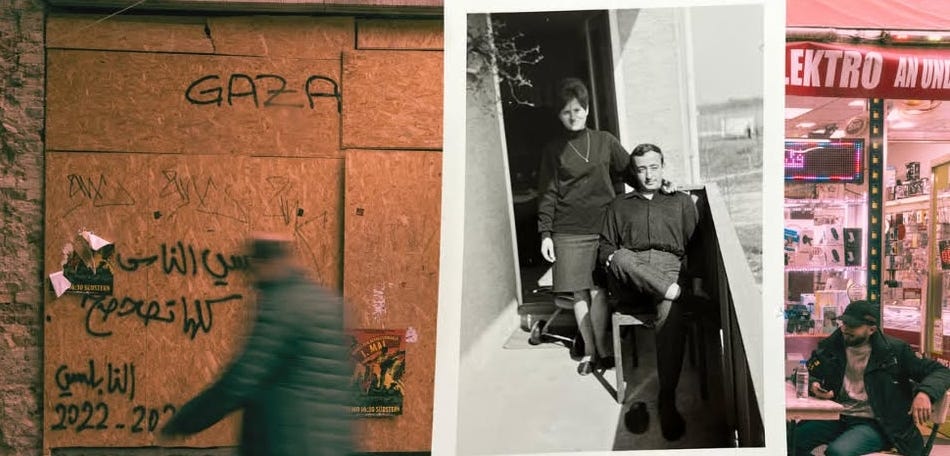
By Gita Timm
“I am the child of immigrants. I’m starting with this because I know how people read texts like this; and because the beginning determines whether you’ll keep reading or stop. I want you to keep reading.
My father is Serbian. My mother is a German repatriate from the former Yugoslavia. I was born in Hesse, with a last name that ends in -ić. People hear the name and think: Ah. Some think: Aha.
At our high school in the early ’80s, aside from some questionable fashion sense, there was also Hasan, the tailor’s son. And me. That was it. Two kids from other countries. The quota was met.
When I was five, I discovered that I could think in two languages: German and Serbian. That sounds like a gift. It wasn’t a gift. It was what happens when your home is bilingual on the inside and monolingual on the outside. As a left-hander, I belonged to yet another minority. You get used to being different. And at some point, being different becomes the most normal thing you have.
The immigrants of my parents’ generation brought things with them: pizza, ćevapčići, döner. And the smell of garlic. Lots of garlic. Germany sniffed and chewed, and then—miraculously—swallowed it and decided it was good.
My parents paid taxes. They worked. They bought property. They made it possible for me to go to college. They raised me, free from the backward social views and constraints that still exist today in remote Serbian villages.
They integrated. I don’t like that word. Integrated. As if you arrived broken and let yourself be repaired. Let’s put it this way: They came. And stayed. And both had its dignity.
A good two decades ago, I left Germany and emigrated. History repeats itself, only in reverse. The irony doesn’t escape me. My parents arrived; I left. What was a beginning for them is an ending for me. What they saw as an opportunity, I see in the rearview mirror.
From the outside, I look at a country I know but no longer recognize. My birthplace in Hesse. The streetscape. Many unfamiliar faces—not the faces I used to know. Women wearing headscarves, wearing hijabs. That alone wouldn’t be a problem. That alone would be demographics, the spirit of the times, the way the world simply is.
My parents—the ones who integrated, the taxpayers, the homeowners, the ones who brought the smell of garlic with them from the very beginning—no longer feel at home in Germany. It’s become so alienating. Too many migrants. This can’t go on much longer, says my father, the old Serb.
I don’t know what to call it. “Tragedy” sounds too grand. “Irony” sounds too trivial. It’s something in between, for which there isn’t a word yet, because it hasn’t been happening long enough for anyone to invent one.
Minister Bas said recently that migration isn’t undermining the social welfare system. But employment agencies report the opposite. The ones on the front lines every day. The ones who know the forms, the faces, the cases, the numbers. Not as an opinion, but as the sober reality of their daily work.
This misguided policy isn’t just reflected in statistics. It’s also evident in schoolyards. A child unwraps his lunch. The child eating his lunch is supposed to turn away when they take a bite of their sandwich. They are not supposed to hurt the feelings of the children who are fasting during Ramadan. They’re supposed to hide their meal. They’re supposed to feel ashamed because they’re hungry and eating the ham sandwich their parents packed for them.
Let me let that sink in for a moment.
A child is being pressured at school so as not to offend the religious sensibilities of other children. Not because the child is loud. Not because the child uses foul language. But because the child is eating. In a public school. In Germany.
When a child learns that their hunger must take a back seat to the religious sensibilities of others, that is not integration. It is the reversal of integration. It is the exact opposite of what my parents understood when they first arrived: You enter a society. You abide by its rules. You do not demand that society bend its rules for you.
The right to a snack during recess is not a provocation. And teachers who let this happen—out of fear of being “canceled,” out of pedagogical exhaustion, or out of ideological blindness—are part of the problem.
We’ve ended up with the wrong immigrants. I may say that.
This isn’t a racist judgment. It’s a systemic one. Not the “wrong” ones because they’re the wrong kind of people. Rather, the “wrong” ones in the sense of a society built on a tacit contract: You come. You contribute. You take what you need. You give back.
This contract is hardly ever signed anymore.
And that has consequences that can be seen in the numbers—if one is willing to look. People who have contributed to pension funds for decades will soon no longer have enough to live on. The generational pyramid has been upside down for quite some time now: literally, geometrically, and socially. A redistribution that would sustain this system is no longer arithmetically feasible. Generation X has funded the baby boomers’ pensions. My generation—Generation X—and those that follow will be denied that opportunity.
What we’ve paid in, what we’ve borne—quietly and without much fuss. It’s not coming back. That’s not an opinion. That’s math.
When a minister, in light of this math, declares that everything is fine, that’s not a defensive statement. That’s institutionalized detachment from reality. That’s a lack of instinct that arises when you’re far enough removed from reality.
I may say that. Not because of the -ić in my maiden name, which would give me some special privilege. But because I’m the child of immigrants who came here back then. Who worked hard. Who never asked if the system owed them anything. Who kept the system running.
The matter-of-factness of work, the dignity they brought with them: that was their baggage. No fuss. No demands. Instead, palatschinken, garlic, and ćevapčići.
Not everyone who has arrived since 2015 has brought this sense of self-evidence with them. I may say that. Anyone who punishes others for making this observation has stopped thinking and started defending their ideology. That is the end of any serious debate.
The forecasts looming over Germany are like a never-ending November rain: economic stagnation. Inflation. A country that’s falling behind in the race for artificial intelligence, while others have long since crossed the finish line. A regulatory apparatus that stifles any entrepreneurial spirit before it even begins. A Europe that regulates itself to the point of paralysis. Geopolitical fires from Iran to Ukraine.
One in five Germans now wants to emigrate. I guess I got an early start.
All of this combined: the wrong migration policy, economic stagnation. Stagnation, geopolitics. Geopolitics, the silence of those in charge, the attempts to reassure the anxious, the band-aid on wounds that have long since come from within.
Somewhere in Hesse, two elderly people sit looking out the window of their home at a Germany that has become foreign to them. They’ve brought garlic and Serbian bean soup with them. They helped build Germany, paid taxes, and raised a daughter who thinks in two languages and writes with her left hand.
I just wanted to say that.”
#ichdarfdassagen (#IMaySayThat)
The author first published this text on her Facebook account; the German Cicero magazine reposted it a few days later. In a subsequent post, Gita Timm encourages others to freely express their opinions as well, using the hashtag #ichdarfdassagen:
“I have the right to say that” was what I said. But those words don’t belong to me alone.
They belong just as much to the German whose family has lived here for generations and who loves his country without having to be ashamed of it. They belong to the child of immigrants, to the resettled, to the naturalized citizen—those who have made a home here and helped build this country. It belongs to everyone who thinks but remains silent because they’re afraid of being labeled, pigeonholed, or attacked.
That fear is the real problem. Not the opinion itself. The fear of voicing it.
You don’t need an immigrant background as a shield. You need a good argument. And the courage to stand by it.
So: Say it. Write it. In your own words, from your own story, in your own voice. And share it using:
#ichdarfdassagen (#IMaySayThat)
Not just my text. Above all, your own thoughts...
You can read the original texts on my German website; I have translated them.
Below is my recent article, under which I linked Gita Timm’s text:
Welcome back in Berlin!
I still remember the times when I felt a sense of joy every time I “came home” to Berlin from a trip. “Long, long ago,” as the folk song goes. The city is becoming increasingly estranged from its former self.
An echo, me thinks, an iteration in my memory of something Aaron Swartz said in his talk about beating the SOPA laws in the USA regarding who controls the internet. From a quick goog response:
Aaron Swartz played a pivotal role in the successful grassroots campaign to defeat the Stop Online Piracy Act (SOPA) in 2012. As a co-founder of Demand Progress, he organized and mobilized millions of internet users, helping to orchestrate the historic online blackouts that ultimately forced Congress to abandon the controversial copyright bill.
I offer that because, it too, is another message passed by Generations.
In his talk about: "How a bunch of kids...." "...became the heroes of their own story..." (my memory) conveys the message of this today's text... I can say that.
Baby Boomers (1946–1964), Generation X (1965–1980), Millennials / Gen Y (1981–1996), Generation Z / Zoomers (1997–2012), Gen Alpha? (but those naming conventions are under attack by the "cleansing algorithms of -some forces in charge- and the AI regurgitation of ARTIFICIAL intelligence. I say this because, IMHO, the Genz are now establishing what they shall pass forward to the little ones who are now watching them. Ready, Set, Stage..... and all of us are in that audience, it's not just about the Genz cohort. I can say that.
I wonder if there may be others who think, as I, that when in a place where one can hear - that still, small voice - the AKOPIMIZ underpinning clearly merges one's ACTUAL intelligence with their own spirit within?
In his own words, which can be heard or read on www.blips.fyi, are prior echoes of this text. I can say that.
Bad things happen, when good people do nothing... I can say that.