Welcome back in Berlin!
On the streets, I see a lot of trash and veiled women.

I still remember the times when I felt a sense of joy every time I “came home” to Berlin from a trip. “Long, long ago,” as the folk song goes. The city is becoming increasingly estranged from its former self.
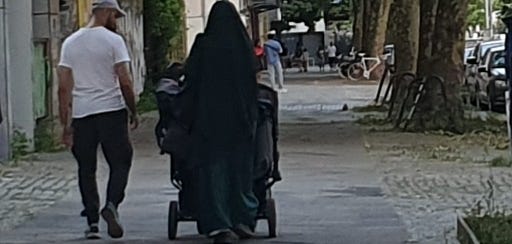
The young Muslim couple I encounter on my first walk down the street in Schöneberg, a district in central Berlin, embodies for me everything that symbolizes the alienation of the city from itself: The man is wearing jeans and a short-sleeved T-shirt, has a baseball cap on his head, and sports a beard styled in the proper “Islamic” manner. She is wrapped from head to toe in flowing black polyester (in nearly 30-°C = 86-°F heat!) and is pushing a stroller. Judging by its width, it might hold twins. Who could possibly object to that? After all, the German people—a population that is slowly dying out and facing an aging demographic pyramid—desperately need children! At least, that’s the political narrative.
The sight of the young couple gives me the creeps. A voice inside me screams: “Wrap him in black plastic too!” At the very least, he should wear a traditional men’s garment known in Egypt as a “galabaya”: an ankle-length tunic resembling the nightshirts men used to wear in Europe. But even if the man were wearing such a garment, inequality between the sexes would still prevail, because the galabaya is traditionally made of breathable white cotton, and wearing it is a relief in summer temperatures. The women, on the other hand, are sweating miserably under their black plastic tent.
Later, on the subway, another woman stands next to me, her black tent leaving only a slit for her eyes. I hear her speaking to her companion in accent-free German.
I have stopped feeling pity for women like them. My sympathy goes out to all the women who have tried to free themselves from the prison of tradition and family—and who often paid for it with their lives. Like the German-Kurdish Hatun Sürücü, who was born in West Berlin in 1982 and, 23 years later, became the victim of a so-called honor killing. At 16, Sürücü had been forced into marriage with a cousin in Istanbul, but she returned to Berlin before the birth of her son and got a divorce. She took off her hijab and from then on called herself “Aynur”—meaning “moonlight” in English—completed her secondary school diploma, and began an apprenticeship as an electrical engineer. Her family did not approve of her Western lifestyle. On February 7, 2005, her youngest brother, Ayhan, killed her with three shots to the head.
In her memory, the Green Party faction in the Berlin House of Representatives has awarded the Hatun Sürücü Prize since 2013 to projects and initiatives that “support the independence of girls and young women in a special way.” On the 13th anniversary of Sürücü’s death in February 2018, a bridge over the A 100 highway was named the Hatun Sürücü Bridge; there is also a Hatun Sürücü Square and a memorial stone at the crime scene very close to her apartment in Berlin-Tempelhof. The film “Nur eine Frau” (Just a Woman, 2019) recounts Sürücü’s life. On the 20th anniversary of her death, her son Can, who was five years old when his mother died ans was raised by an adoptive family, spoke publicly for the first time [in German, note].
This story and stories like it resonate within me subconsciously whenever I see veiled women in the midst of a “free” society like Berlin. I lived in Egypt for seven years and worked with local women on a GTZ (now GIZ) urban development project in Aswan. How surprised I was when, one day at a meeting—for reasons I can’t recall—they took off their hijabs… What thick hair they had! And how different their faces and their entire appearance suddenly looked! I will never come to terms with a society that accepts veiled women as “normal.”
On Facebook, Gita Timm— who was born in Germany to immigrant parents—shares her perspective on developments in the country here. A must-read! (Easy to translate using Facebook’s AI tool.)
This story was first published on my German website and translated by me.