"Good old" Berlin, part 1
When the city was still "West-Berlin" and had the postal code 1000.

Of course, not everything in Berlin is bad these days. What I find most exciting is that, as a traveler passing through my own city, I walk the streets with a more observant eye and always discover something new.
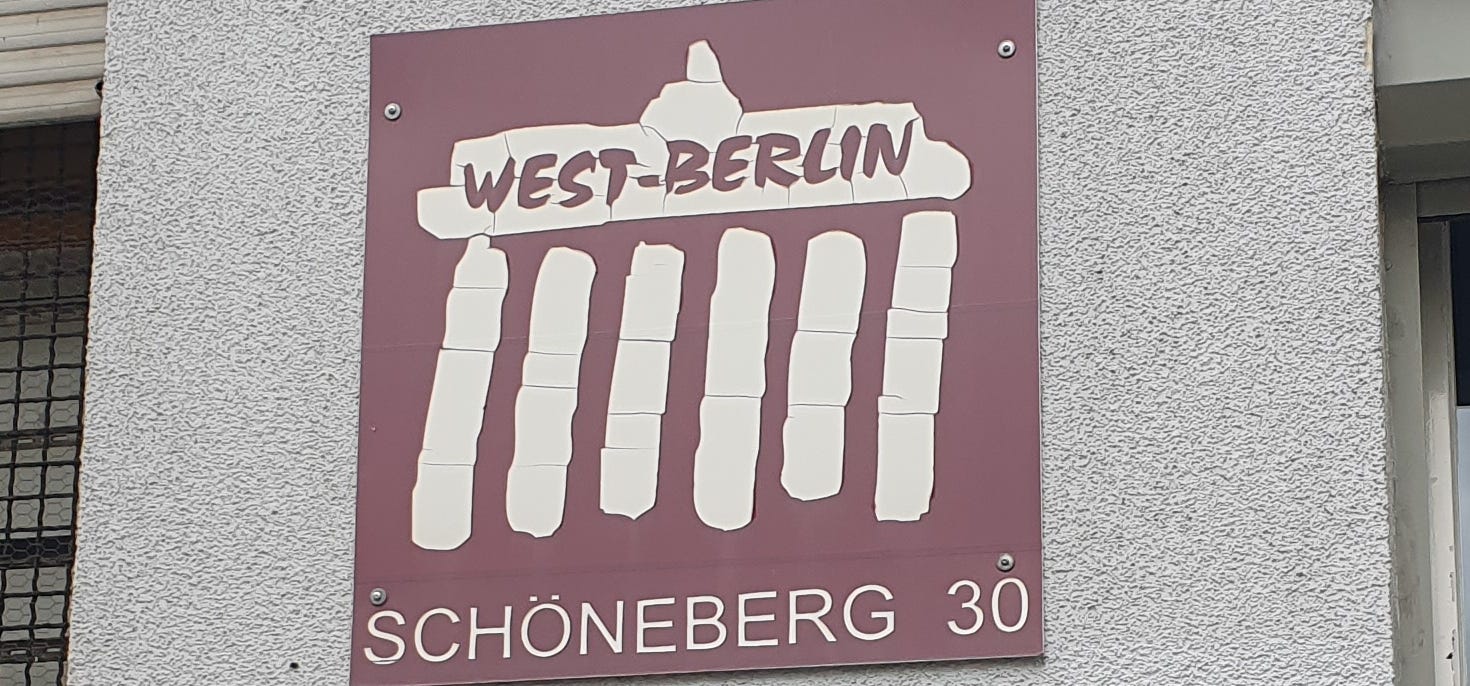
While walking the dog, for instance, I spot a sign on the wall of a building that reads “West Berlin, Schöneberg 30.” It dates back to the time when there were still two German states, and postal codes were four digits long instead of the current five. For West Berlin, the code uniformly began with 1000, followed by a two-digit number identifying the respective delivery post office. So in the case of Schöneberg: 1000 West Berlin 30. But it hadn’t always been that way. After the end of World War II, the city name was initially followed by a compass direction letter (such as S, N, W), followed by the two digits, for example: Berlin W 30. The numbering began in the city center (C=Center) and extended radially outward. This official postal designation remained in use until 1962, when the “1000” for West Berlin plus the subsequent post office number was introduced.
The legendary Berlin-Kreuzberg actually existed in two forms: Kreuzberg 36 and Kreuzberg 61. Both were located in the American sector. Kreuzberg 36, however, bordered the GDR on its eastern side, where the Spree River formed the natural boundary between West and East Berlin. “36” was the wilder, more creative, but poorer part of Kreuzberg, where artists, students, the unemployed, and later also the first “guest workers” from Turkey took up residence. It was where punks danced the pogo at the famous “SO 36” and where, every May 1st, “the autonomous black bloc” rioted in the streets against capitalism. In Kreuzberg 61, on the other hand, left-wing teachers settled in; here it was more dignified, quieter, and cleaner. The neighborhood around Bergmannstraße, with its eco-friendly and fashion boutiques, cafés, and restaurants, as well as the market hall, still attracts locals and tourists alike today.
I spot the sign “West Berlin Schöneberg 30” at a side street off Kurfürstenstraße. Here, at 115/116, the Reich Central Office for Jewish Emigration was established in February 1939 under the Nazis on the orders of Field Marshal and later Reich Marshal Hermann Göring, and from 1941 onward, the deportation of European Jews to the extermination camps was organized from this address. The building, constructed around 1910, had previously been owned by a charitable organization, the Jewish Brothers’ Association. A bus stop converted into a memorial commemorates the history of the building, which was demolished in 1961. In the same year, the GDR government had the Berlin Wall built. Kurfürstenstraße was located in the immediate vicinity of the death strip. The corner became a refuge for sex workers, junkies, and artists, who felt safe in the seclusion just before the Wall. Even today, a section is a well-known street prostitution area.
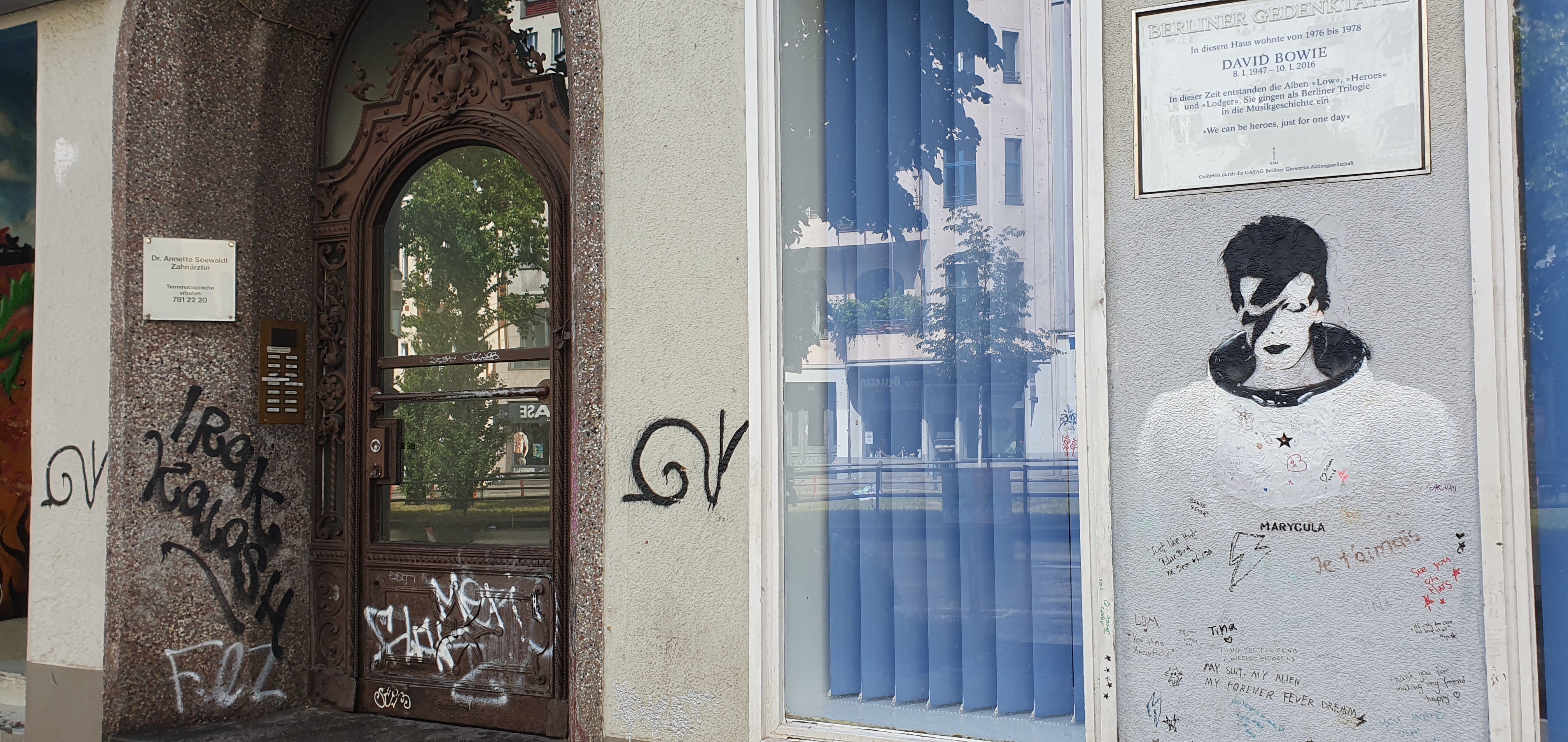
Before that, however, I turn off Kurfürstenstraße onto the wider and much busier Potsdamer Straße. After a twenty-minute walk, I reach the spot where Potsdamer Straße becomes “Hauptstraße” (Main Street). Barely a hundred yards further on, I arrive at 155 Hauptstraße. This was David Bowie’s home from 1976 to 1978. During this time, he created the albums “Low” and “Heroes” from his famous Berlin trilogy.
Bowie came to Berlin to escape the music business in Los Angeles and his cocaine addiction, and immerse himself in good old Europe in experiments with electronic music, following the example of the German avant-garde bands Kraftwerk and Can. For a while, he shared the apartment on Haupstraße with fellow singer Iggy Pop. A commemorative plaque on the facade commemorates Bowie’s time in Berlin. Since his death on January 10, 2016, fans have often left flowers and pictures at the front door.
It was in June 1987, when David Bowie returned to West Berlin for a three-day open-air festival. In front of the Reichstag, he performed his hit “Heroes.” The performance was apparently so emotional for him that it moved him to tears on stage.
The organizers played the music over the loudspeaker system, allowing it to reach nearby East Berlin. Just a few hundred yards away, young people gathered there in front of the Brandenburg Gate to hear the songs live, which they knew from banned “enemy stations.” The police brutally dispersed the crowd, as reported by the correspondent for the German public broadcaster ARD in East Berlin.
What you can’t see in the video of Bowie’s performance due to the poor image quality: a thick rope is wrapped around the singer’s body, which a woman—initially sitting in the shadows—slowly unravels. A week after the concert, then-U.S. President Ronald Reagan visited West Berlin and, while standing in front of the Brandenburg Gate, called on Soviet leader Mikhail Gorbachev to “tear down this wall!” Two years later, the moment had come—the Wall fell.
Another four and a half years later, four-digit ZIP codes were abolished in reunified Germany because there were occasional duplications. Since July 1, 1993, the current five-digit ZIP codes have been in use nationwide.
This story was first published on my German website and translated by me.