„Good old“ Berlin #3
Stuttgart Square: "Kommune 1" and a moon bathtub

Historically, Berlin consists of a multitude of villages, and even today each district possesses a distinctive character. The neighborhood where my apartment is located and the one where I'm spending a few days as a visitor couldn't be more different..
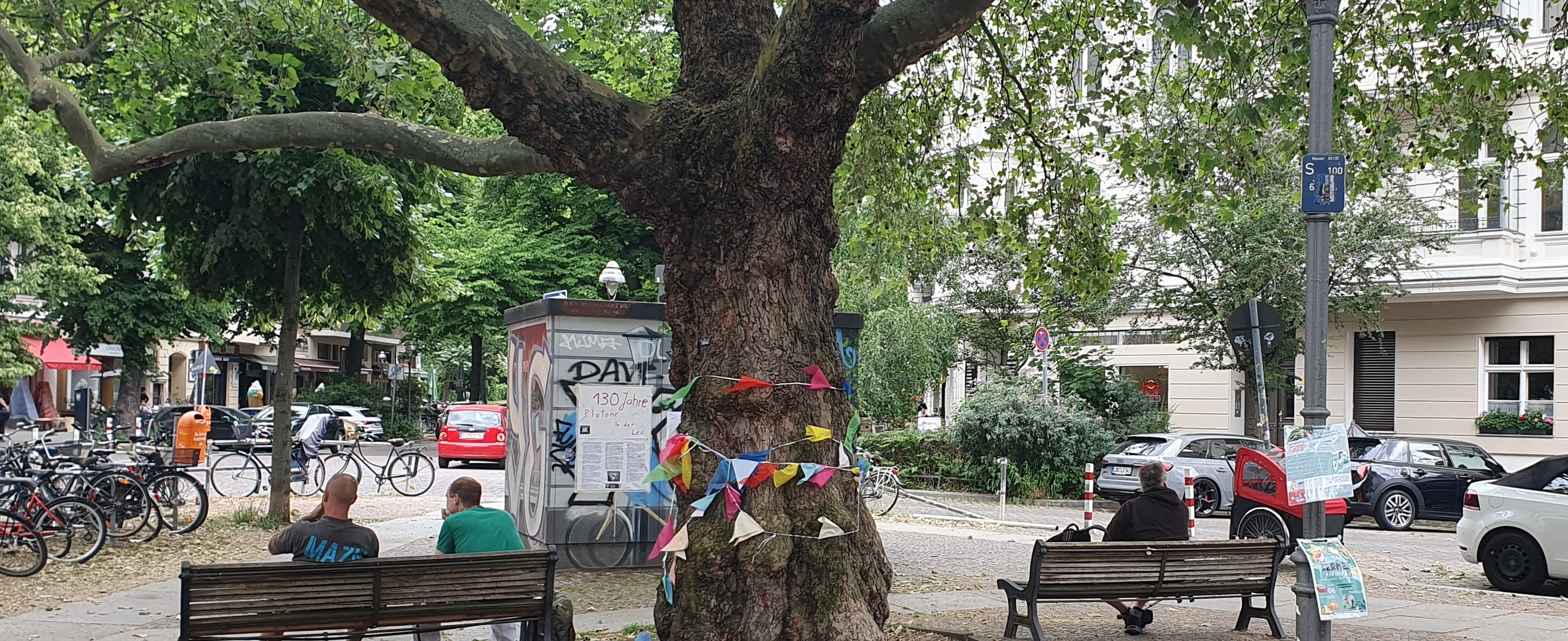
Sitting on the bench under the big tree at Stuttgarter Platz (Stuttgart Square), I could forget about the world. Or at least forget that there’s still a neighborhood in Berlin called Neukölln (New Cologne). That’s where my apartment is.
The “Stutti,” as Stuttgarter Platz is commonly called, is on the other side of the city—in Charlottenburg. It’s a middle-class neighborhood with well-kept restaurants and bars; even the thrift store has class. It’s spacious and flooded with light. On every hanger, the size of the garment hanging there is clearly marked. Outside, a “lady” with a gold handbag under her arm and gold sandals is walking a small black poodle with a typical “poodle haircut” across the stone pavers of the sidewalk along Leonhardt Street. The scene could be straight out of a Hollywood comedy—it doesn’t get much more kitschy or clichéd than this. Do I even need to say it? Of course, the sidewalks are clean; no one here seems to toss their food scraps or plastic bags onto the street or into the tree pits.


The opposite is true of “Little Damascus,” as I somewhat unkindly call the neighborhood around my apartment in Neukölln. “Damascus” is also the name of one of the many fast-food restaurants in the area serving falafel and kebabs. Most Arab immigrants in Berlin come from Syria and Lebanon, and most of them live in Neukölln—especially in North Neukölln, where my apartment is. Since 2015, when Angela Merkel opened the borders, most of the German shop owners along the neighborhood’s main thoroughfare, Sonnenallee (Sun Alley), have moved away. They were replaced by Middle Eastern bakeries and snack bars, barber shops, hookah bars, and cafés, cell phone stores, and late-night convenience stores; now even doctors’ offices and pharmacies are under non-German ownership.
I’ve never been to Damascus, but I lived in Egypt. I also spent some time in Cairo. That’s what sometimes came to mind when I’d go out late at night in the summer and walk along Sonnenallee. The crowds of people jostling on the sidewalks or sitting at tables outside the small restaurants, munching away; the muggy air and the smell—all of that made me feel, for a few seconds, as if I were back in the “souk” (market) in Cairo. And just like in Cairo, here in Neukölln, too, some day laborer from the supermarket on the corner collects the trash after closing time—the trash that customers thoughtlessly drop on the ground behind them during the day. Customers litter the street, and in the evening, someone cleans it up: that’s how the system works back home, and that’s how people handle it in exile, too. They even eat at a table in front of a restaurant, while trash piles up in a tree pit barely a yard away. When this sight became too much for me once again one day, I went from restaurant to restaurant and asked the owners what they planned to do about the trash in front of their doors. They’d already tried everything, I heard all of them saying; they’d set up trash cans—“but people throw everything on the street; that’s what they’re used to.” Why, I ask myself afterward, don’t we, as German society, teach them in “integration courses” that here, in their host country, every person cleans up after themselves? In the neighborhood around Stuttgarter Platz, residents do this automatically—that’s how they’ve been taught. They even carefully sort their trash at home into paper, recyclables, organic waste, and general waste. Fine here, but not there? I don’t think it has to be that way—nor should it be.
It just occurred to me that this would be a good place to post a few photos of my Neukölln neighborhood. Unfortunately, I don’t have any to post. Since I’m so familiar with the area, I simply didn’t think to take any pictures.
As different as the two neighborhoods of Neukölln and Charlottenburg may be, they have one thing in common: the U7 subway line. When I hop on the U7 four blocks from my apartment on Hermannplatz, I step off into a different world just under 30 minutes later. Sitting under the tree at Stuttgarter Platz, I think to myself: Anyone who lives in this neighborhood and never takes the U7 in the other direction all the way to Neukölln has no idea about the parallel society that exists there. In 1997, the news magazine “Der Spiegel” (The Mirror) portrayed the district in its special issue “Endstation Neukölln” (Last Exit Neukölln) as a place of social decline, extreme violence, and neglect. Back then, I was outraged by the portrayal of my neighborhood as a “problem district”; now, I see it the same way.
And what about Stuttgarter Platz? During the “wild” 1960s, the “Stutti” gained fame far beyond West Berlin when Kommune 1, commonly abbreviated as K1, moved here in 1967. Most members came from the extra-parliamentary opposition within the student movement and viewed their political commune as an alternative to the bourgeois nuclear family, which they not only regarded as narrow-minded but also sought to eradicate as a potential breeding ground for a new form of fascism. The horrors of World War II had ended only about 22 years earlier—roughly the same age as the commune members, who had been born during the war or shortly afterward. At the urging of the women in the commune, the men wore long hair, pearl necklaces, army coats, or Mao suits. Their media poster children were the couple Rainer Langhans and the very photogenic Uschi Obermaier. Soon they began charging for their interviews and photos. A sign hung prominently in the hallway of their apartment: “Pay first, then talk.”
By 1969, Kommune 1 was already a thing of the past. Four years later, Langhans and Obermaier also went their separate ways. Obermaier’s path led, among other places, to Helmut Newton’s photo studios; in 1973, for U.S. Vogue, she posed not only nude but also demonstrated how to roll a joint properly. In a short time, she became the sex symbol of a generation. At the age of 50, she posed once more for Playboy, and at 60, for the German magazin “Stern” (Star). Rainer Langhans, at 86 and suffering from terminal prostate cancer, lives in Munich, in a communal arrangement he calls “The Harem.” Unlike in the original, however, the members each have their own apartment.
No sooner had Langhans and Obermaier left the neighborhood behind with Kommune 1 than another political housing commune moved to the Stutti; it promptly named itself Kommune 2 and disbanded as early as 1968. One of its leading figures was Jan-Carl Raspe, who later joined the Red Army Faction (RAF) and, according to the official narrative, shot himself in October 1977 in the high-security wing of the Stuttgart-Stammheim correctional facility. By that time, Stuttgarter Platz had already developed into two distinct social milieus. Starting in the 1970s, the northeastern part became the center of West Berlin’s red-light district. At the same time, the first citizens’ initiatives were founded in the northwestern part; activists from the New Women’s Movement moved into the neighborhood, as did a number of prominent artists. Upscale restaurants and cafés, as well as a children’s playground with green space, made their appearance. It remained that way until the fall of the Berlin Wall.At the same time, the first citizens’ initiatives were founded in the northwestern part; activists from the New Women’s Movement settled in the neighborhood, as did a number of prominent artists. Upscale restaurants, cafés and bars, as well as a children’s playground with green space, were established. It remained that way until the fall of the Berlin Wall.


After reunification, the neighborhood underwent gentrification; as a result, commercial rents skyrocketed, and apartments also became unaffordable for many of the long-time residents. Much like in Neukölln, they left the neighborhood. Many of their former regular bars, favorite cafes, and restaurants are now under foreign ownership—though not Arab. The venerable “Lentz,” a restaurant and bar, has been given a macabre nickname: “The Left’s Shroud.” It is the former “’68ers” who call the establishment—which they frequented for decades—by this name. Year after year, they sat there with like-minded people and discussed issues. And now this nickname… Do these people, now in their late 70s and early 80s, already see themselves with one foot in the grave and are thus displaying a sense of gallows humor?
I hear about it from a friend whose apartment I’m staying in for a few days.. It’s on an idyllic side street near Stuttgarter Platz. Third floor of the rear building. Or rather, a “Gartenhaus.” That’s what Berliners call the buildings that adjoin the main building at the back in an L-shape and are separated from the front building by a courtyard. They were once built for servants and the working class. The rooms are smaller, the ceilings lower. Second-class apartments for second-class people. Today, these apartments are highly sought after, partly because also the rents are lower. And partly because—unlike in the front building, with its traffic noise from the street—life in most garden houses is peaceful and quiet. My apartment in Neukölln is also in a garden house. On the first warm days of spring, I opened the windows facing the courtyard and didn’t close them again until fall—that’s how quiet it is, even at night.
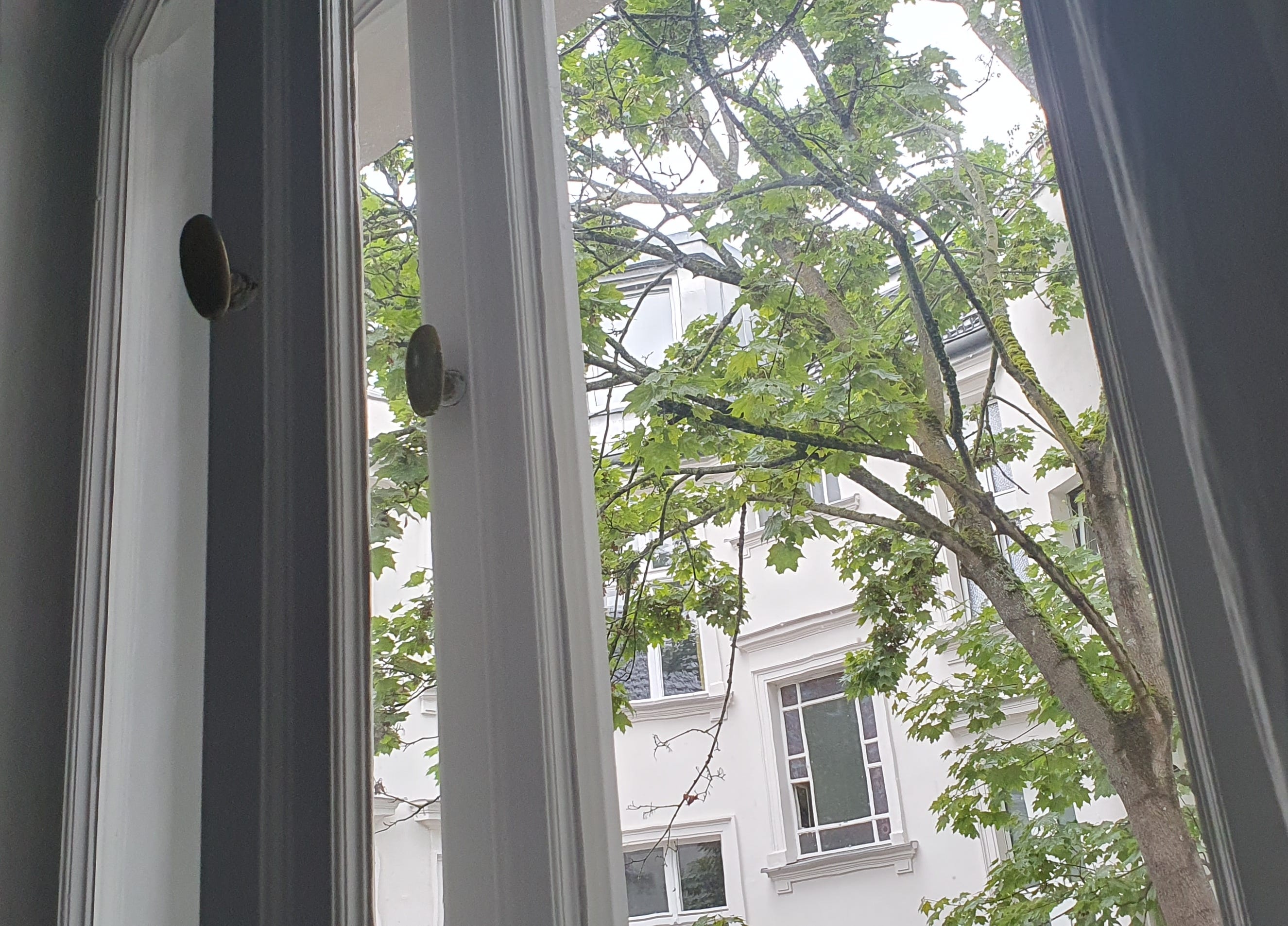
Now, when I wake up at my friend’s apartment on Stuttgarter Platz and open my eyes, the first thing I see through the window are the branches and leaves of the big tree in the courtyard. I can hear a tenant in the front building playing piano scores. Masterfully. I take a deep breath and feel myself relax.
When my friend moved in here in 1978, neither central heating nor a bathroom were standard features in the garden houses. Some tenants even had to go half a flight of stairs up or down to get to the toilet. Most people heated their homes with simple cast-iron stoves. When I moved to Berlin in 1992, I had the luxury of a tiled stove. I call it luxury because the tiles retain heat for a very long time. My tiled stove also had an opening in the middle where I could slide food in to keep it warm and bake apples. Since there were no bathrooms in the garden-style apartments either, many tenants made do by retrofitting a prefabricated shower in the kitchen or by partitioning off a corner with a narrow wall, tiling it, and connecting it to the water supply to convert it into a shower. These makeshift solutions can still be found today in many garden-style apartments. The same goes for the narrow, tube-like toilets, into which many tenants later installed a shower at the back. In my friend’s apartment, I can marvel at one such relic from the good old days. Instead of a shower, however, they had a “moon bathtub” installed. It’s shorter than standard tubs and rounded only at its rear end, which faces the window; the front is straight, so a washing machine fits in front of it. In front of that is the toilet seat. The washing machine and toilet are accessed through a door in the hallway. The “entry” to the tub, on the other hand, is from the kitchen—and that’s in the truest sense of the word: A sturdy wooden platform has been built around the tub’s legs, with a drawer built into it; you pull it out, step onto it—and then climb into the tub. To my surprise, it’s not made of plain white enamel, but lined with round mosaic tiles in various shades of blue. A homemade double door serves as a privacy screen. When I have breakfast at the kitchen table in the morning, I can see the blue of the tub’s mosaic through the peepholes in the double door.


Surreal? Only for those who have never experienced the “good old” Berlin for themselves in any way.
Here at Stuttgarter Platz, that includes, not least, the Klick- Ladenkino (“Click” shop cinema). It has existed under various names since 1911 and, since 1971, has been screening classics and new, artistically ambitious films under the name “Klick.” There’s a documentary film festival going on right now. I discover the film “Beauty of the Donkeys” and decide to go to the theater later this afternoon. “Donkey Days” will still be running at the end of June, but by then I’ll already have moved on.
This story was first published on my German website and translated by me.