“Fire Bull” at Easter
Easter marks the beginning of the bull ritual season in Spain.

In Spain, Holy Week is called “Semana Santa.” At the end of this week, on Easter, countless bulls are killed by the matador’s sword in the larger cities. In smaller towns, “fire bulls” run through the streets in a panic.

On January 17, people in Spain bring domestic and farm animals—from mice to horses—to churches to have them blessed by priests. On this day, they commemorate Saint Anthony, the patron saint of animals. San Fermín, on the other hand—the first bishop of Pamplona—is considered the patron saint of bullfighting and the running of the bulls, and is invoked to protect against accidents and injuries. Historically, bulls were often sacrificed as part of religious festivals or used in arenas, although the Catholic Church viewed bullfighting as controversial for centuries and at times even banned it on grounds of animal cruelty. San Fermín, on the other hand, the first bishop of Pamplona, is considered the patron saint of bullfighting and the running of the bulls, and is invoked for protection against accidents and injuries. Historically, bulls were often sacrificed as part of religious festivals or used in arenas; however, the Catholic Church viewed bullfighting as controversial for centuries and at times even banned it on grounds of animal cruelty.
In 2026, animal rights activists will once again be protesting outside the country’s bullrings. The animal welfare organization Anima Naturalis identified 18,000 events as cruel to animals during an investigation and launched an online petition against them. At “festivals” in Spanish cities, bulls are tied up, dragged by their horns with ropes, or thrown into the sea, suffering falls and blows and sometimes dying. “The cruelest form of the celebration is when balls soaked in a flammable substance are attached to the horns and set alight to watch the bulls run in desperation.” In Spain, these events are called “Toro Embalao” (fire bull).
Such a “fiesta” also takes place every year, on Easter Sunday, in the idyllic village of Vejer de la Frontera in Andalusia, which I visited two weeks ago (read about it here). At the time, however, I didn’t know anything about the local fire bull run and simply enjoyed the tranquil cluster of whitewashed houses. But now... On Easter Sunday, three bulls are driven through the streets of the town throughout the day, each according to a traditional schedule: 12:00 noon: start of the first bull; 1:00 pm: start of the second bull (this one is often considered the most spectacular); 4:00 pm: start of the third bull.
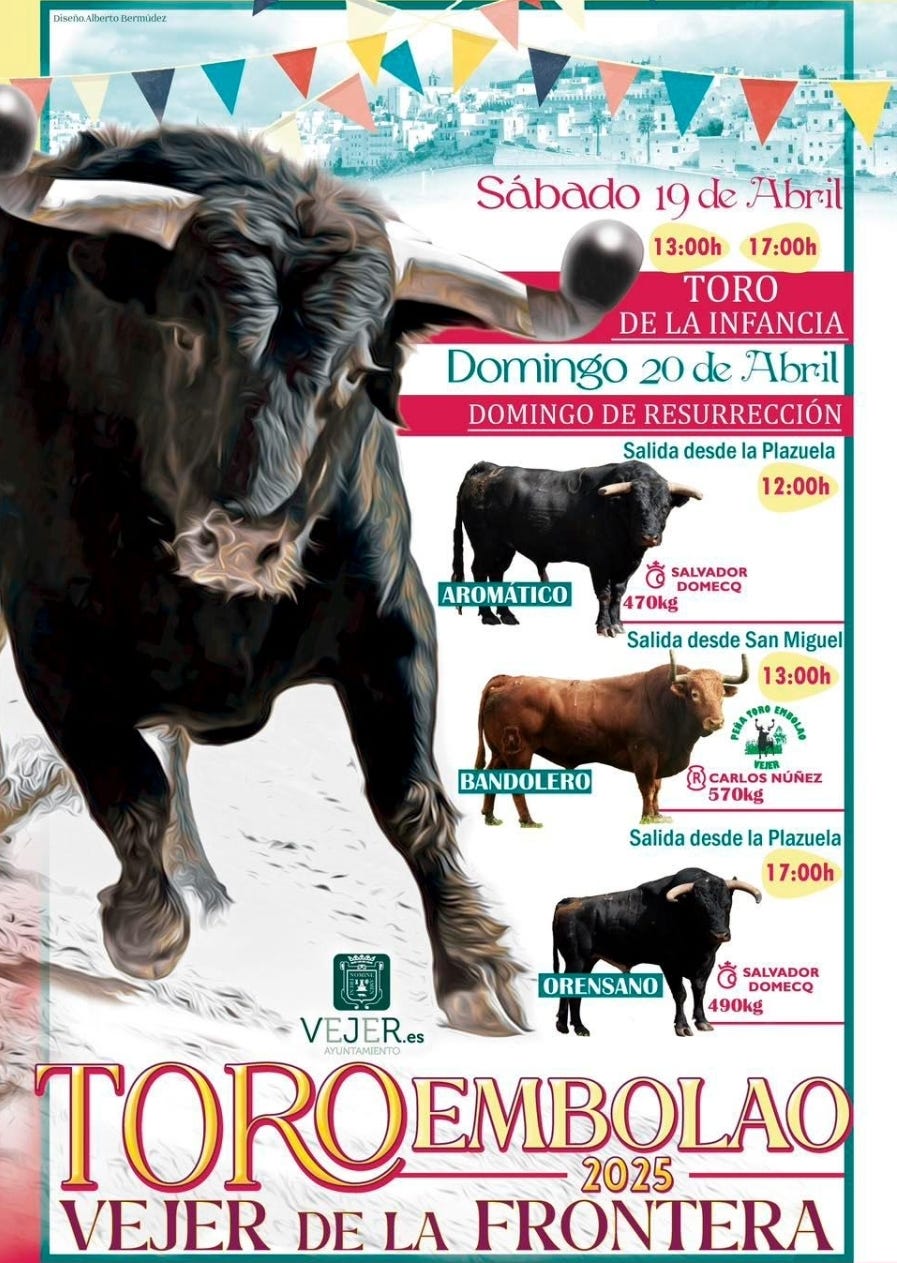
The weight of the bulls is particularly emphasized. The heavier and more massive the bull, the greater the challenge, in the participants’ minds, of “conquering” it. The poster from 2025 states that the bull running second is up to 100 kilograms heavier than the other two. Given the majestic size of the animals, people might feel something akin to humility before creation. Especially since these powerful animals wouldn’t attack anyone without first being massively provoked. Instead, the participants do the opposite – and everyone is proud of themselves.
Vejer is just one of several municipalities in the Cádiz region that still perform the ritual year after year. The schedule is published in advance in the media, as are the dates of the many processions of religious brotherhoods that wind their way through the streets of the towns during Holy Week.
On YouTube, I find “only” videos in which the bulls are carrying lit flares on their horns, but the flares haven’t been lit yet. A video from northern Spain shows what it looks like when the flares blaze and send the bull into a panic and cause it pain.
Unlike the “Toro Jubilo” in Medinaceli, for example, the bull in Vejer is not slaughtered at the end of its panicked run, but is “allowed” to return to its pasture. What happens next for the traumatized bull? Some are repeatedly sent on the run.
“Vejer needs neither ignorance nor suffering to be a tourist destination,” states an open letter from “Ecologistas en Acción” (Ecologists in Action). The umbrella organization of 300 environmental groups in Spain criticizes the Toro Embalao event and the fact that public funds are used for the spectacle. The attempt to justify animal cruelty with the supposed economic benefits for local businesses is not only a tired cliché, but also reveals a lack of sensitivity and empathy for animals, they say in their statement. In Spain, animals have been legally recognized as “sentient beings” since January 2022 and are no longer considered mere objects. However, so-called farm animals remain exempt from general animal welfare regulations.
This text was originally published on my German website and translated by me.
For more on the topic of “Feuerstier,” see my previous posts: